Free online sudoku with no ads: unlimited puzzles from easy to expert, a daily puzzle, notes, hints and undo. Every grid has exactly one solution.
- Genre
- Puzzle
- Players
- Single player
- Devices
- Phone and desktop
- Daily
- A new puzzle every day
- Price
- Free, plays in the browser, nothing to install
How to play
Tap a cell, then tap a number. Keyboard: arrow keys move, 1-9 fill a cell, Backspace or 0 clears it, N toggles pencil notes, H gives a hint, U undoes.
New in v1.2
A new catalog cover, drawn by the game itself.
How to play
Sudoku is played on a 9×9 grid split into nine 3×3 boxes. Some cells start filled in. Your job is to fill the rest.
- Every row must contain the digits 1 to 9, each exactly once.
- Every column must contain the digits 1 to 9, each exactly once.
- Every 3×3 box must contain the digits 1 to 9, each exactly once.
- The starting digits, called givens, cannot be changed.
There is no arithmetic involved. The digits are just symbols, so the puzzle is pure logic. A well made sudoku has exactly one solution, and you can reach it by reasoning alone.
Strategy
Start by writing candidates. For an empty cell, the candidates are the digits not already used in its row, column or box. Most techniques are ways of crossing candidates out.
- Naked single. A cell has only one candidate left. Write it in. This is the most common move in easy puzzles.
- Hidden single. A digit fits in only one cell of a row, column or box, even if that cell still has other candidates. Scanning each box for each digit finds these quickly.
- Naked pair. Two cells in the same unit share exactly the same two candidates, for example 3 and 7. Those two digits must go in those two cells, so remove 3 and 7 from every other cell in that unit. The same idea works for triples.
- Hidden pair. Two digits can only go in the same two cells of a unit. Those cells must hold those digits, so any other candidates in them can go.
- Pointing. Inside one box, all the candidates for a digit sit in a single row or column. The digit must land in that line within this box, so remove it from the rest of that line outside the box.
- Box/line reduction. The reverse of pointing. In a row or column, a digit's candidates all fall inside one box. Remove it from the other cells of that box.
- X-wing. A digit has exactly two possible cells in each of two rows, and those cells line up in the same two columns. The digit must take opposite corners of that rectangle, so remove it from the rest of both columns. The same works with rows and columns swapped.
A good habit: after every placement, look at the row, column and box you just touched. That is where the next single usually appears.
History
Sudoku grew out of the Latin square, a grid where each symbol appears once per row and column. The modern puzzle, with the extra rule for 3×3 boxes, was first published in 1979 by Dell Magazines in the United States under the name Number Place. It is usually credited to Howard Garns.
The Japanese publisher Nikoli introduced it in Japan in 1984 and gave it the name Sudoku, a short form of a phrase meaning "the digits must remain single". In late 2004 The Times in London began printing computer-generated puzzles supplied by Wayne Gould, and by 2005 sudoku was running in newspapers around the world.
Playing on Summoned Games
- Four difficulty levels. Easy starts with 40 givens and Medium with 34, and both can be solved with singles alone. Hard starts with 29 givens and Expert with 25, and these are built to need techniques beyond singles.
- Unlimited puzzles. Every new game is generated on the spot, and the generator checks that it has exactly one solution.
- Daily puzzle. One medium puzzle per day, the same for every player, with a streak counter for days in a row.
- Notes. Toggle Notes to write pencil marks. Placing a digit clears it from the notes of every cell in the same row, column and box.
- Help when you want it. Undo steps back, Erase clears a cell, and Hint fills in one correct digit.
- Mistakes counter. A digit that does not match the solution turns red and adds to the counter. Repeated digits in a row, column or box are also marked.
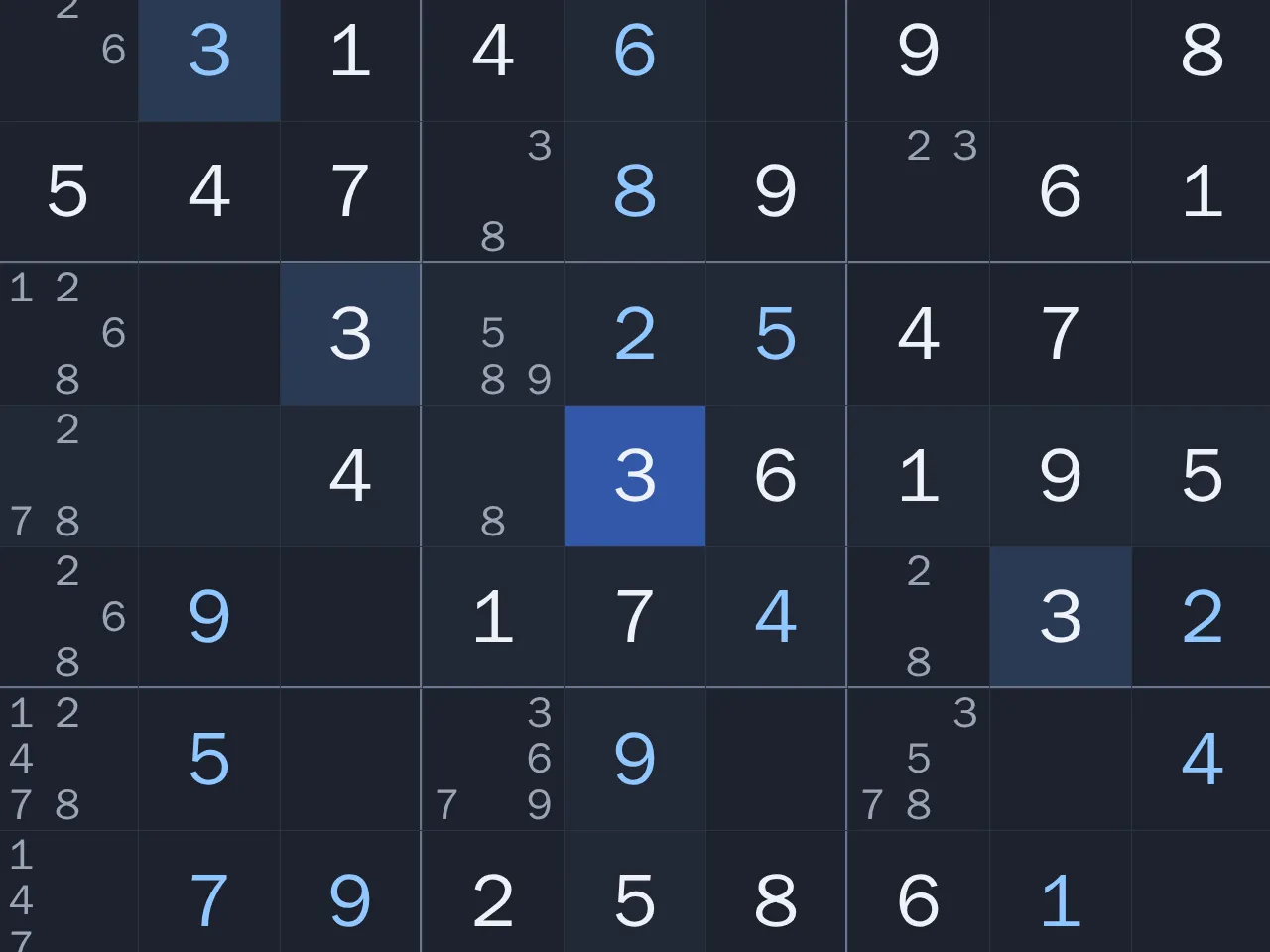
- Highlighting. Selecting a cell shades its row, column and box and highlights every matching digit. The number pad shows how many of each digit are still to place.
- Leaderboards for total puzzles solved and for the fastest Hard or Expert solve.
- Saves itself. Close the tab and your puzzle, notes and timer are waiting when you come back.
On a phone, tap a cell, then tap a digit on the pad. On a keyboard, use the arrow keys to move, 1 to 9 to enter, Backspace or Delete to erase, N for notes, H for a hint, U or Ctrl+Z to undo and Esc for the menu.
FAQ
Is every puzzle solvable without guessing? Yes. Every puzzle has exactly one solution, so it can be reached by logic. Easy and Medium only need singles. Hard and Expert call for stronger techniques such as pairs, pointing or an X-wing.
Is it free? Yes. Sudoku on Summoned Games is free to play in the browser, with no ads.
How does the daily puzzle work? There is one daily puzzle per day, at medium difficulty, and every player gets the same one. Solve it on consecutive days to build a streak.
What happens if I enter a wrong digit? It turns red and the mistakes counter goes up by one. You can erase it or use Undo and keep going. There is no limit on mistakes.
Can I play on my phone? Yes. The grid and number pad are built for touch, and the game works the same with a mouse and keyboard on desktop. Your puzzle saves automatically, so you can stop and pick it up later.