Nonogram puzzles online, free with no ads: unlimited 5×5 to 20×20 grids and a daily 10×10, each with one solution you can reach without guessing.
- Genre
- Puzzle
- Players
- Single player
- Devices
- Phone and desktop
- Daily
- A new puzzle every day
- Price
- Free, plays in the browser, nothing to install
How to play
Touch: tap a cell to fill it, tap again to clear. Switch to Cross mode (✕) to mark cells you know are empty. Drag along a row or column to paint several cells. Check highlights wrong fills, Undo takes back the last stroke, Zoom enlarges big grids. Keyboard: arrow keys move, Space or Enter fills, X toggles fill/cross mode, right click crosses, Backspace clears, U undo, C check, Z zoom, Esc menu.
New in v1.2
A new catalog cover, drawn by the game itself.
How to play
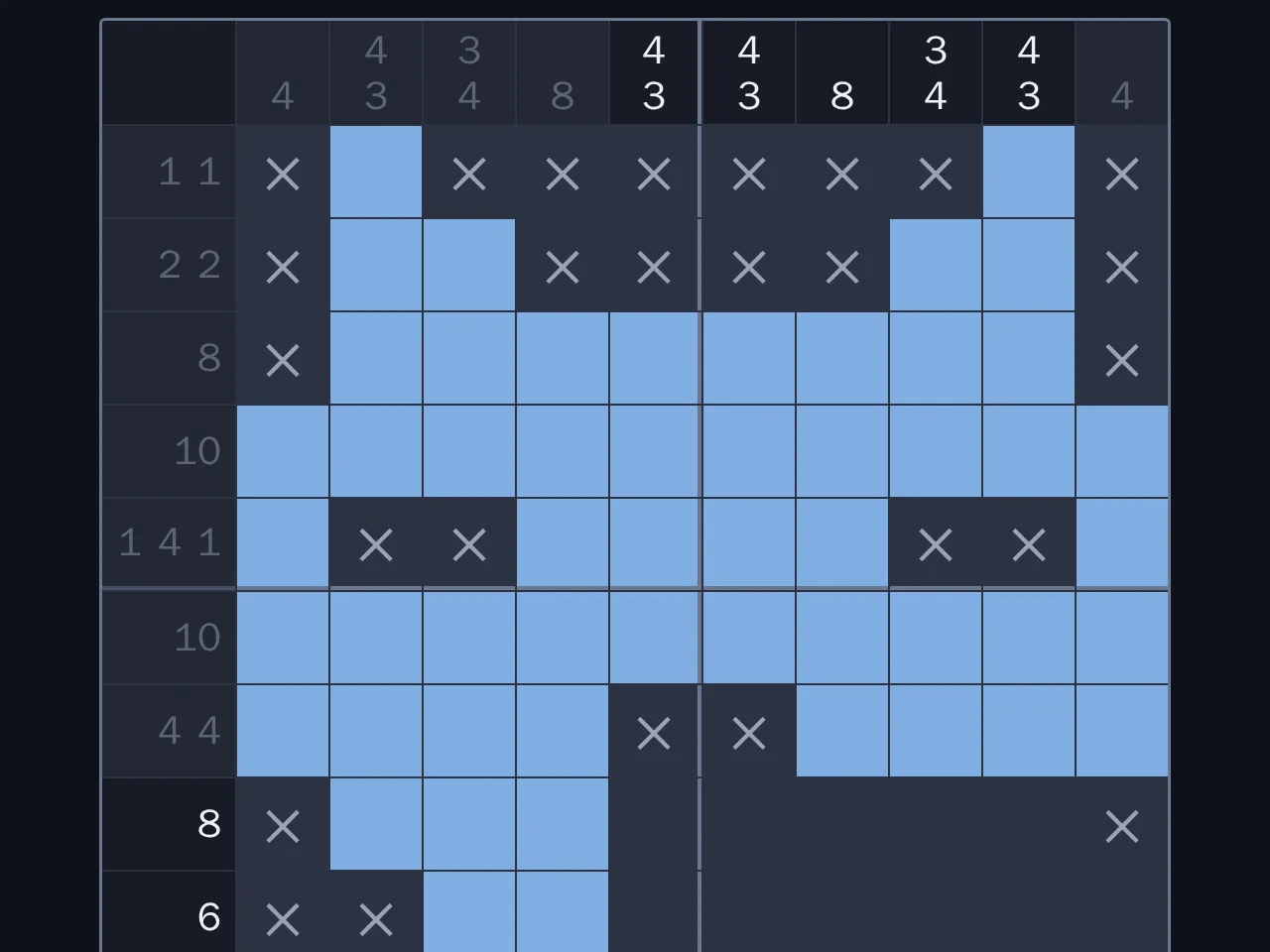
A nonogram is a grid of blank cells with number clues beside each row and above each column. You fill cells to match the clues.
- Each clue lists the lengths of the runs of filled cells in that line, in order. A row marked
3 1holds a run of three filled cells, then later a single filled cell. - Runs in the same line are separated by at least one empty cell. There may also be empty cells before the first run and after the last.
- A line with no clue beside it is entirely empty.
- Every cell sits in one row and one column, so a filled cell has to fit both clues.
- The puzzle is solved when every row and column matches its clue.
Crosses are for your own notes. Put a cross in any cell you know is empty, so you can see the gaps while you work.
Strategy
Start with the big clues. A clue that almost fills its line leaves little freedom. In a 10-cell row with a clue of 10, every cell is filled. With a clue of 9, the middle eight are filled whichever way the run slides.
Use overlap. Place each run as far left as it can go, then as far right. Any cell covered by the same run in both placements must be filled. This works for lines with several runs too: push them all left, then all right, and compare each run with itself.
Add up the clue. Total the runs plus one gap between each pair. If the total equals the line length, there is only one way to place them, so fill the line at once.
Mark the empties. When a line's runs are all placed, cross the rest. Crosses split the line into shorter pieces, and a piece too short for any remaining run must be empty.
Work from the edges. A filled cell next to the border, or next to a cross, has to be the start of a run. If the first clue in that line is 4, the next three cells are filled too.
Cap finished runs. Once a run reaches its full length, the cells at both ends of it must be empty. Cross them.
Switch direction often. Every cell you fill or cross gives the crossing line new information. Good solving moves back and forth between rows and columns until the grid is done.
History
Nonograms are picture logic puzzles from Japan. They were created in the late 1980s by Non Ishida, a Japanese graphics editor, and the name joins her first name with "diagram". The puzzles spread through newspapers and puzzle magazines in Japan and then the UK during the early 1990s. Nintendo's Picross games on the Game Boy and later consoles made them popular around the world, and they are also known as Griddlers, Hanjie and Paint by Numbers.
Playing on Summoned Games
Pick a 5×5, 10×10, 15×15 or 20×20 grid, or play the daily 10×10 puzzle, the same for everyone that day. New puzzles are generated on demand, so they never run out. Each one is an abstract pattern rather than a drawing, and each is checked to have exactly one solution that you can reach by working one line at a time, with no guessing.
A clue dims once the cells in its line match it. The Check button highlights any filled cell that should be empty, and adds one to the mistake counter when it finds something. Undo steps back through your moves. Your progress saves as you play, so you can close the tab and resume from the menu.
Solved puzzles count toward the puzzles solved leaderboard, and 15×15 grids have a leaderboard for the fastest time. Your best time for each size and your daily streak show in the menu.
On a phone, tap a cell to fill it, or switch the Fill button to Cross mode to mark empties. Drag along a row or column to fill or cross several cells in one stroke. On desktop, left click fills and right click crosses. Keyboard players use the arrow keys, Space or Enter to fill, X to switch modes, C to check, U to undo and Z to zoom.
FAQ
Do I ever have to guess? No. Every puzzle here is generated so that row and column logic alone solves it, and it has exactly one solution.
What do the crosses do? Nothing for the score. They mark cells you know are empty. The puzzle checks only filled cells, so you can leave other cells blank.
Is a nonogram the same as Picross or Griddlers? Yes. Picross, Griddlers, Hanjie and Paint by Numbers are other names for the same kind of puzzle.
Which size should I start with? Start with 5×5 to learn the rules, then move to 10×10. The 15×15 and 20×20 grids take longer and need more back and forth between rows and columns.
Is it free? Yes. It runs in the browser with no ads and no download.