Free online kakuro (cross sums) with no ads: unlimited puzzles from 6×6 to 12×12, a daily puzzle, notes and hints. Each one solvable by pure logic.
- Genre
- Puzzle
- Players
- Single player
- Devices
- Phone and desktop
- Daily
- A new puzzle every day
- Price
- Free, plays in the browser, nothing to install
How to play
Touch: tap a white cell, then tap a digit. Notes toggles pencil marks, Erase clears a cell, Undo takes back a move, Hint reveals the selected cell. Keyboard: arrow keys to move, 1-9 to enter, Backspace to erase, N notes, H hint, U undo, Esc menu.
New in v1.1
A new catalog cover, drawn by the game itself.
How to play
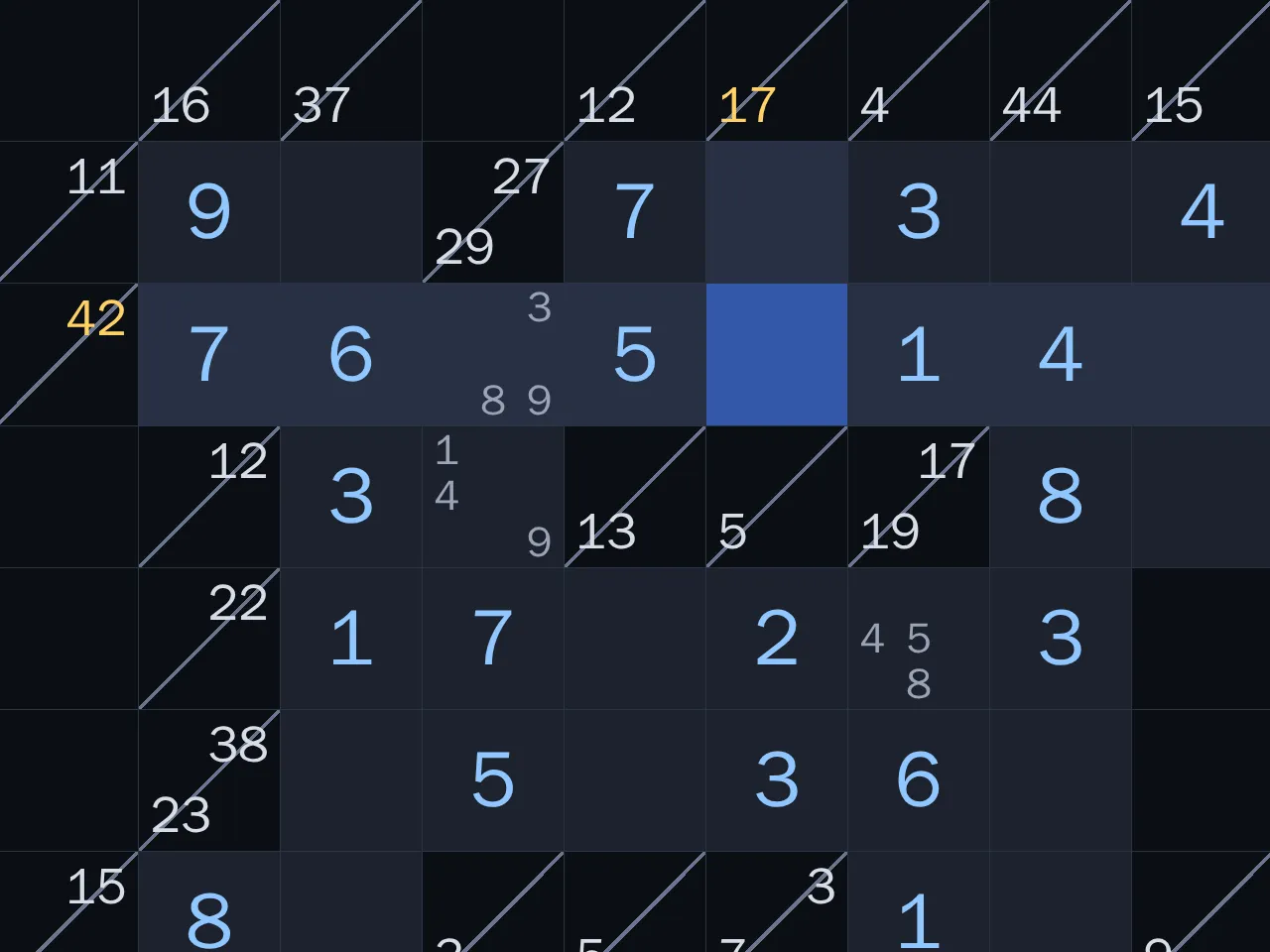
Kakuro looks like a crossword, but with numbers. The grid has black clue cells and white cells to fill. A line of white cells running across or down, without a black cell in between, is called a run.
- Fill every white cell with a digit from 1 to 9.
- The digits in a run must add up to its clue. The clue sits in the black cell just before the run.
- A digit cannot repeat inside a run.
- Black cells with a diagonal line hold two clues. The number above the diagonal is the sum for the run to its right. The number below it is the sum for the run going down.
Each white cell belongs to one across run and one down run, so every digit has to satisfy two sums at once. That crossing is what makes the puzzle solvable.
Strategy
Kakuro is mostly about knowing which sets of digits can make a given sum.
- Unique combinations. Some sums have only one possible set of digits. In two cells, 3 is always 1+2, 4 is 1+3, 16 is 7+9 and 17 is 8+9. In three cells, 6 is 1+2+3, 7 is 1+2+4, 23 is 6+8+9 and 24 is 7+8+9. In four cells, 10 is 1+2+3+4 and 30 is 6+7+8+9. Start with these runs.
- Crossing runs. Where a run that must be {1, 2} crosses a run that must be {1, 3}, the shared cell has to be 1. Look for the overlap of two candidate sets.
- Excluded digits. Some digits can never appear in a run. A 2-cell run of 10 cannot hold a 5, since 5+5 repeats. A 3-cell run of 23 cannot hold anything below 6.
- Required digits. If every combination for a run contains the same digit, that digit must be somewhere in the run. If it only fits in one cell, it goes there.
- Remaining sum. Once some cells of a run are filled, the leftover cells must add up to what remains. A run of 15 in three cells with a 9 already placed needs 6 from the other two, so they are 1+5 or 2+4.
- Large and small digits. A run with a high sum pushes toward 7, 8 and 9. A low one pushes toward 1, 2 and 3. Where a high run crosses a low run, the shared cell is usually something in the middle.
Pencil marks help a lot. Write the possible digits for each cell, then cross them out as runs cross each other.
History
Kakuro first appeared in the United States in Dell puzzle magazines under the name Cross Sums. The Japanese publisher Nikoli brought it to Japan around 1980, and the name Kakuro comes from a shortened Japanese phrase for "addition cross". It was hugely popular in Japan long before it reached Europe. After the sudoku boom, British newspapers started printing it in 2005, and it is still sold as both Kakuro and Cross Sums.
Playing on Summoned Games
- Four grid sizes. 6×6 for easy, 8×8 for medium, 10×10 for hard and 12×12 for expert. Layouts are symmetric, and runs are between two and nine cells long.
- Unlimited puzzles. Every game is generated fresh, with the clues tuned until the solution is unique.
- Solvable by logic. The generator only accepts a puzzle when sum combinations and crossing runs alone settle every cell, so you never have to guess.
- Daily puzzle. One 8×8 puzzle per day, the same for every player, with a streak counter.
- Run helper. Tap a cell and the strip under the grid shows both of its runs: the clue, the length, and how much is left to place. Digits already used in those runs are greyed out on the number pad.
- Notes, Undo, Erase and Hint. Pencil marks clear themselves when you place that digit in the same run, and a hint fills one correct digit.
- Mistakes counter. A wrong digit turns red and is counted. A run with a repeated digit or a total that goes over its clue is flagged.
- Leaderboards for puzzles solved and for the fastest 10×10 solve.
- Auto-save keeps your grid, notes and timer if you leave mid-puzzle.
On a phone, tap a white cell and then a digit. On a keyboard, the arrow keys jump between white cells, 1 to 9 enters a digit, Backspace or Delete erases, N toggles notes, H gives a hint, U or Ctrl+Z undoes and Esc opens the menu.
FAQ
What do the two numbers in a clue cell mean? The number above the diagonal is the sum of the run to the right. The number below the diagonal is the sum of the run going down.
Can a digit repeat in a run? No. Each run uses different digits. The same digit can appear twice in a row of the grid if a black cell separates the two runs.
Do I need to guess? No. Every puzzle here can be finished by working out sum combinations and where runs cross.
Which size should I start with? Start with 6×6. It has short runs and few clues to track. Move to 8×8, the size of the daily puzzle, once the common combinations feel familiar.
Is Kakuro free to play? Yes. It is free in your browser on phone or desktop, with no ads.