Hashi (Hashiwokakero, Bridges) online: a free daily puzzle plus unlimited 7×7 to 17×17 grids, no ads. Every puzzle has one solution and saves as you go.
- Genre
- Puzzle
- Players
- Single player
- Devices
- Phone and desktop
- Daily
- A new puzzle every day
- Price
- Free, plays in the browser, nothing to install
How to play
Touch: tap an island, then tap an island in line with it to add a bridge; tap the pair again for a double bridge, a third time to remove it. Tap a bridge to cycle it. Zoom button for the big grids. Keyboard: arrow keys move between islands, Enter or Space selects and connects, Backspace removes the last bridge, U undo, C check, Z zoom, Esc menu.
New in v1.2
A new catalog cover, drawn by the game itself.
How to play
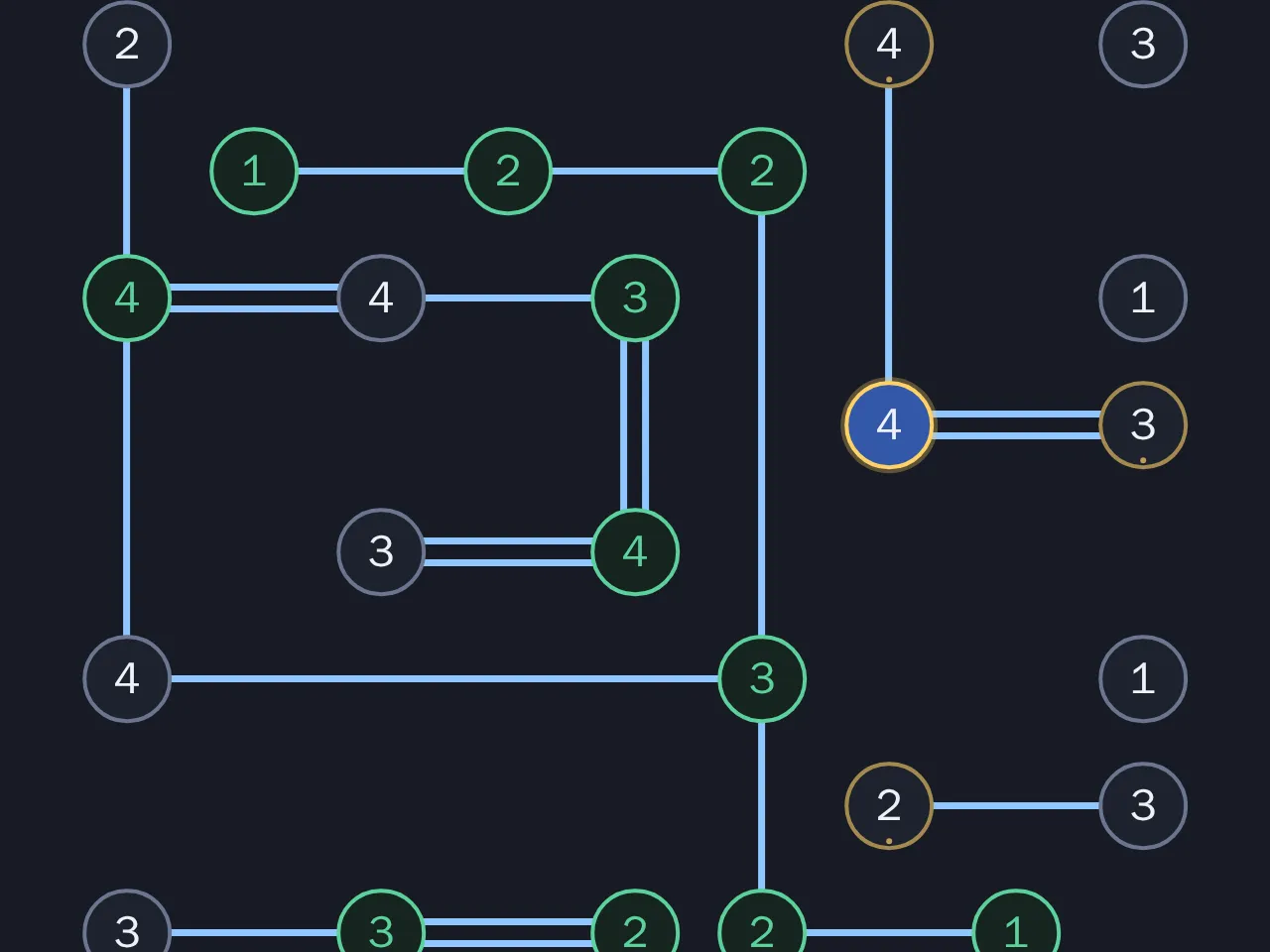
Hashi is played on a grid scattered with numbered circles called islands. Your job is to connect them with bridges.
- Each island's number says exactly how many bridges end at it.
- Bridges run in straight lines, horizontally or vertically, between two islands. They never bend and never pass over another island.
- Two islands can be joined by one bridge or two parallel bridges, never more.
- Bridges may not cross each other.
- When you finish, every island must be connected into a single group, so you can travel from any island to any other along bridges.
A puzzle is solved when every island has its count, nothing crosses, and the whole map is one connected network.
Strategy
Count the neighbours. An island can link to at most four others: the nearest island up, down, left and right. Each link carries at most two bridges. So a 4 with only two neighbours must take a double bridge to both. A 6 with three neighbours needs doubles on all three, and an 8 always takes doubles in every direction.
Guaranteed singles. If an island's number is one less than the maximum its neighbours could carry, every neighbour must get at least one bridge. A 5 with three neighbours, or a 3 with two, works this way. Draw the single bridges first and come back for the doubles later.
Corners and edges. Islands on the border have fewer neighbours, so they fill up fast. Look at corners and edges early.
Avoid closed groups. Two 1s can never join each other, since that pair would be finished and cut off from the rest. Likewise two 2s cannot take a double bridge between them. In general, never complete a small group whose islands are all satisfied while other islands still exist. This isolation rule often decides which of two options is right.
Blocking. A bridge cuts every possible link that would cross it. After you place one, check which islands just lost a neighbour, because their counts may now be forced.
Remaining capacity. As islands fill, subtract what is already placed. An island that still needs 2 and has only one open neighbour must take a double there. Keep re-reading the board with these reduced numbers.
On large grids, work in waves: sweep for forced moves, apply them, then sweep again.
History
Hashi is short for Hashiwokakero, Japanese for "build bridges". The puzzle was developed and popularised by Nikoli, the Japanese publisher also behind many other pencil puzzles. In English it is often sold simply as Bridges.
Playing on Summoned Games
Pick a grid from the menu: 7×7 (Easy), 10×10 (Medium), 13×13 (Hard) or 17×17 (Expert). Each new puzzle is generated on the spot, so there is no limit to how many you can play, and the generator only keeps puzzles with exactly one solution.
The daily puzzle is a 10×10 grid that is the same for everyone on a given day. Solve it on consecutive days to build a daily streak, which shows on the menu with your best time for each size.
On a phone, tap an island and then another island in line with it to build a bridge. Tap the same pair again to make it a double, and once more to remove it. You can also tap an existing bridge directly to cycle it. If a bridge would cross an existing one, the game refuses it and tells you why. Zoom enlarges big boards so islands are easy to hit.
On a desktop, the arrow keys hop between islands, Enter or Space selects and connects, Backspace removes the last bridge, U or Ctrl+Z undoes, C checks, Z zooms and Escape returns to the menu.
Check tells you how many islands have the wrong count, whether everything is connected, and flashes wrong bridges. Each wrong bridge it finds adds to the mistake counter beside the timer. Your game saves automatically, so you can leave and resume later. Solving a puzzle adds to the puzzles solved leaderboard, and 10×10 times, including the daily, go on the fastest 10×10 board.
FAQ
What does Hashiwokakero mean? It is Japanese for "build bridges". Hashi is the short form, and Bridges is the common English name.
Does every puzzle have exactly one solution? Yes. The generator solves each puzzle before showing it and throws away any grid with more than one answer.
Can bridges cross each other? No. Bridges can never cross, and the game will not let you place one that does.
How many bridges can join two islands? At most two. Tap a pair once for a single bridge, twice for a double, and a third time to clear it.
Is there a new puzzle every day? Yes. The daily 10×10 changes each day and is the same for every player, and you can play unlimited random puzzles at any size besides.