Free online futoshiki with no ads: unlimited inequality puzzles from 4×4 to 9×9, a daily 6×6, notes, hints and undo. Every grid has one solution.
- Genre
- Puzzle
- Players
- Single player
- Devices
- Phone and desktop
- Daily
- A new puzzle every day
- Price
- Free, plays in the browser, nothing to install
How to play
Touch: tap a cell, then tap a number below the board. Notes toggles pencil marks, Erase clears a cell, Undo takes back a move, Hint fills the selected cell. Keyboard: arrow keys move, 1-9 enter a number, Backspace or 0 erases, N toggles notes, H hint, U undo, Esc opens the menu.
New in v1.2
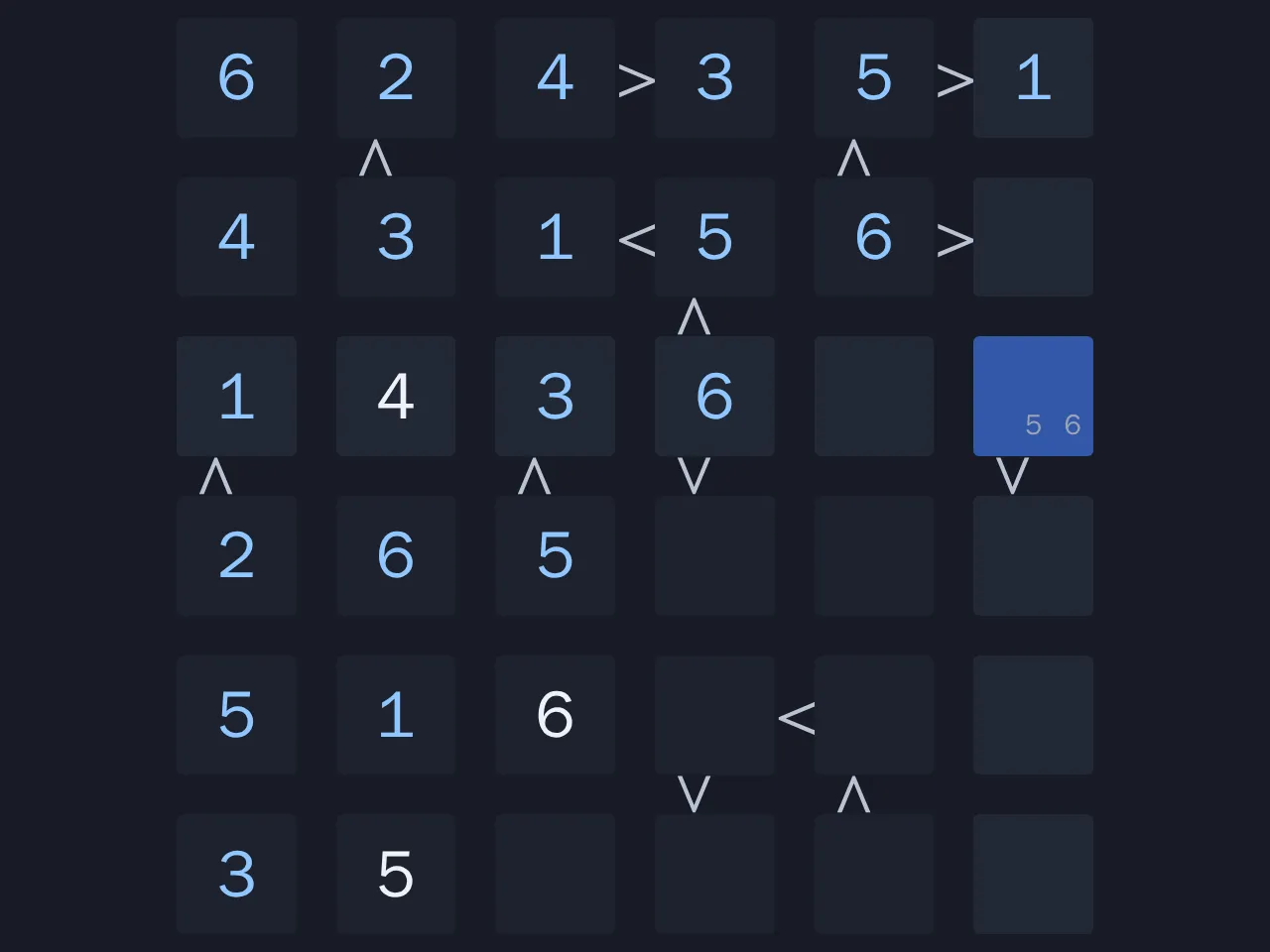
A new catalog cover, drawn by the game itself.
How to play
Futoshiki is played on a square grid, usually from 4×4 up to 9×9. Some cells may start with a number, and some pairs of neighbouring cells have an inequality sign, < or >, between them.
- In an N×N grid, fill every cell with a number from 1 to N.
- Each row must contain every number from 1 to N exactly once.
- Each column must contain every number from 1 to N exactly once.
- Every inequality sign must be true. The open side of the sign faces the larger number, so in 2 < 4 the 4 is on the wide side. Signs between vertically stacked cells work the same way.
There are no boxes as in sudoku. The signs do the work that the boxes and extra givens would otherwise do, and a good puzzle has exactly one solution.
Strategy
- Edge values. A cell on the small side of a sign can never hold N, and a cell on the large side can never hold 1. This alone clears a lot of candidates at the start.
- Chains. Signs often link into chains, such as a < b < c. In a chain of three cells, the first cell is at most N-2 and the last is at least 3. Longer chains squeeze the values even more, and a chain of N cells across a whole row fixes every value in it.
- Bounds through neighbours. If a cell can only be 4 or 5 and the cell on its small side must be smaller, the neighbour can be at most 4. Push the highest and lowest possible values along each sign.
- Singles. As in sudoku, a cell with one candidate left takes that number. A number that fits in only one cell of a row or column goes there.
- Pairs. If two cells in a row can only hold the same two numbers, those numbers are used up, so remove them from the rest of the row.
- Combine directions. A cell often sits between a sign in its row and a sign in its column. Apply both, then check what the row and column already contain.
Write candidates for every cell early. Futoshiki moves fast once the first few cells near long chains are fixed.
History
Futoshiki comes from Japan, and its name means "inequality". It is built on the Latin square, a grid where each symbol appears once per row and column, with comparison signs added as clues. After the sudoku boom of the mid-2000s, British newspapers began printing it, and in the UK it is also known as More or Less.
Playing on Summoned Games
- Five sizes. 4×4 Easy, 5×5 Medium, 6×6 Tricky, 7×7 Hard and 9×9 Expert. Bigger grids start with more signs and a few more numbers, but each also asks you to track more cells.
- Unlimited puzzles. Every game is generated fresh, and a solver confirms it has exactly one solution.
- Gentle starts. The 4×4 and 5×5 puzzles can be finished with simple deductions alone, with no need to try a value and backtrack.
- Daily 6×6 puzzle. One per day, the same for every player, with a streak counter.
- Notes. Pencil marks are cleared from the row and column when you place a number.
- Undo, Erase and Hint. A hint fills one correct number into the selected cell, or into a random open cell.
- Mistakes counter and timer. A wrong number turns red and is counted. Repeats in a row or column, and any sign that two filled cells break, are marked.
- Leaderboards for puzzles solved and for the fastest 7×7 solve.
- Auto-save keeps your grid, notes and timer if you leave mid-puzzle.
- Rules card. A How to play screen in the menu explains the signs with small examples.
On a phone, tap a cell and then a number on the pad. On a keyboard, move with the arrow keys, type a number, erase with Backspace or Delete, and press N or F for notes, H for a hint, U or Ctrl+Z to undo and Esc for the menu.
FAQ
Which way does the sign point? The open, wide side of < or > faces the larger number. The point faces the smaller one. In 3 < 5, the 5 is on the open side.
Is futoshiki like sudoku? Both ask you to place each number once per row and column. Futoshiki has no 3×3 boxes, and its main clues are the inequality signs between cells.
Does every puzzle have a unique solution? Yes. Each puzzle is checked by a solver before it is shown, and only kept if there is exactly one answer.
Which size should I start with? 4×4 is a quick introduction to the signs. The daily 6×6 is a good next step, and 9×9 is the longest and hardest.
Is it free? Yes. Futoshiki is free in your browser on phone or desktop, with no ads.