Build. Battle. Break the Meta. A roguelike autobattler where you don't fight — your machine does. Draft enchanted weapons, engines, curses and clockwork companions, arrange them on a 4×4 forge grid so they power each other, and watch the chain reactions play out. Seven quick rounds, three hearts. Publish your final build to the arena and challenge friends with a link — they can fight it even while you're offline. A Daily Forge seed lets everyone race the same run.
How to play
Drag items with mouse or finger (or tap an item, then tap a cell). Rotate with ⟳ or R; while dragging on a phone, tap with a second finger. Tap any item for its rules. In battle: play/pause, step event by event, 1–8× speed, skip, full log.
New in v1.8
Clearer run summaries for builds that run on independent timers.
How to play
Arcane Forge is a short roguelike autobattler. You never press an attack button: you build a machine out of items, and the machine fights for you.
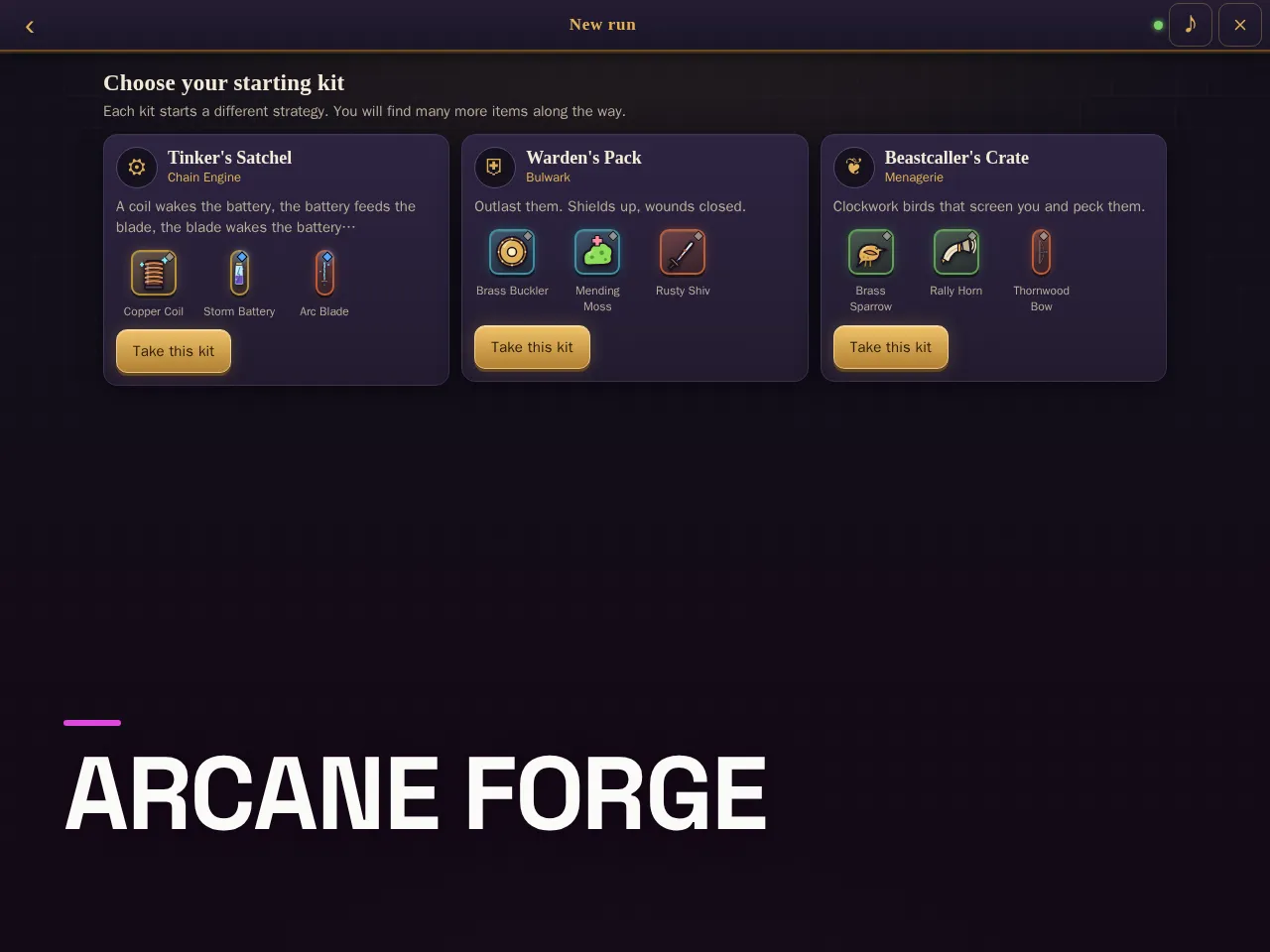
- Pick a starting kit. Each kit points at a different strategy.
- Arrange your forge. Items sit on a 4×4 grid. Only items on the grid fight; the bench holds spares.
- Choose an opponent. Every round offers three — Easy, Even and Hard. Harder fights pay more points and better rewards. You can scout them before you commit.
- Watch the battle. Items activate on their own timers or when something else happens: a battery charges whenever a neighbour works, a blade strikes whenever you gain energy, a switch passes activations along the direction it points. Pause, step through it event by event, or skip.
- Grow. After each fight pick a new item. Temper items to change how they work, and meet the Wandering Artificer for runes, glyphs and dark bargains.
- Seven rounds, three hearts. Win the final bout to become Forge Champion.
- Publish. Save your final build and send it to the arena. Other players meet it as an opponent, and anyone with your challenge link can try to beat it.
The Daily Forge
Once a day everyone gets the same seed: the same starting kits, the same draft dice and the same NPC opponents. Your best score of the day goes on the Daily Forge board, so you can compare the exact same run with everyone else.
Position matters
Many items affect adjacent items, their row and column, or the item an arrow points at. The forge draws glowing links between items that feed each other and shows the bonuses each item will start the battle with. Rotating a long item changes its neighbours.
Item families
- Weapons deal damage. Some Pierce past minions, some Sweep through them.
- Catalysts amplify or redirect other items: whetstones, echo prisms, relay switches, mimic cogs.
- Engines make ⚡ energy and extra activations.
- Defenses shield, heal, mitigate and punish attackers with Thorns.
- Curses are strong and costly — and Bound to you once taken.
- Companions summon minions that screen you and swarm the enemy.
Strategy
Five archetypes emerge: burst damage, damage over time, defensive sustain, activation chains and summoning. Each has counters — cleansing beats poison, shields beat burst, sweep attacks and thorns beat swarms, Rot beats healing, Frost and energy drain break chains, and scaling damage beats turtles.
FAQ
Is combat random? No. Battles are fully deterministic: the same two builds and battle seed always produce the same fight, so every replay is exact and the battle log shows the real rules being applied.
Do I need other players online? No. Published builds live in the arena and fight on their creator's behalf. When the arena is quiet, named NPC forgers and generated builds fill the gaps.
How do challenge links work? Publish a saved build, then copy its link. Whoever opens it plays a run whose final opponent is your build — no install or account needed.
What carries over between runs? Runs are self-contained. Renown unlocks extra starting kits, the curse family, forge themes and cosmetic effects, but never raw power.